Sunday, August 26, 2012

How many squares?

I keep seeing this puzzle on Facebook, so I'm posting my systematic solution here.


There's a pattern of 16 basic squares in a regular 4  x  4 grid, plus two more superimposed on that grid to create 8 small squares.

First consider the basic squares.  There are 4 x 4 = 16 of them.

Now group them into 2 x 2 squares. There are 3 of those across:


and there are obviously 3 of them down also, so there are 3 x 3 = 9 of them.

If you do the same using 3 x 3 squares, there are 2 across and 2 down, so there are 2 x 2 = 4 of them.

And of course if you group them into a 4 x 4 square, there's just 1 of those.

Now if you do the same with the two superimposed squares, there are 8 small squares and 2 large squares:


So the total number of squares is:

16 + 9 + 4 + 1 + 8 + 2 = 40

Thursday, August 23, 2012

Your life in 5-year snapshots

Here's something new: describe your life on a single page by writing single-sentence snapshots of your life at 5-year intervals. Here's my one-page history:

5 years ago: Teaching math, science and information technology at an independent school in British Columbia.

10 years ago: Independent consultant doing functional specification documents for industrial software development projects in Georgia (US).

15 years ago: Staff consultant at software company in Seattle, applying their products to customers' needs and designing software to fill any gaps.

20 years ago: Selecting computers, designing networks and implementing process management software at large new pulp mills in northern Alberta.

25 years ago: Teaching computers, electronics and logic to engineering technologists at a new division of a college in Surrey, British Columbia.

30 years ago: Developing software to automate the startup of a process plant in British Columbia.

35 years ago: Overseas resident control systems engineer for a project to design and build a large pulp and paper mill in Poland.

40 years ago: Owner/operator of an business doing recording, editing, and duplication of radio programs and educational material in Vancouver, BC.

45 years ago: University student and anti-apartheid activist in Durban, South Africa.

50 years ago: At boarding school in Lusaka, Zambia completing A-level university entrance requirements in math and science.

55 years ago: Completing elementary school and editing the class annual.

60 years ago: Leaving the UK and flying to my new home in Northern Rhodesia.

65 years ago: Learning to hate the daily spoonful of cod liver oil all British kids got from the National Health System!

Sunday, April 08, 2012

Servant Leadership

I just found in my archive the talk I gave on Wednesday 26 October 2005 at Heritage Christian School's Grade 12 Leadership Retreat. I thought others might like to read it. The quotations from the Bible are from the New Living Translation.
_ _ _ _ _

There are 13 people here tonight - the same number as Jesus and his disciples. This must be how it felt for them to be together.

I have friends in Israel, so I keep track of Jewish holidays. Today is Simchat Torah, when the Jews celebrate the glory of the Law. Not the giving of it - that's celebrated at Pentecost - but its glory. Yet in the New Testament, Paul says in 2 Corinthians 3:6 "[God's] new covenant...is not one of written laws, but of the Spirit. The old way of the Law ends in death; in the new way, the Holy Spirit gives life." Paul didn't say the law was bad - on the contrary, he says several times in Romans that the law is good - but it doesn't bring life. Only the Holy Spirit does that.

Here are some thoughts about Servant Leadership:

1.  The need for leadership is a consequence of sin.

Who led the first humans? God did. When did God first put one human in authority over another? After the Fall. When did Israel first get a king, and why? See 1 Samuel 8:4.

2.  Leadership is hard work!

In today's Leadership exercises, one group put "lazy" in their list of characteristics a leader should not have. That's right!  Leaders work hard, long hours, and their work is emotionally draining. And it's absolutely essential! A recent book studied the failures of many large American corporations and concluded that it's not particular styles of management that cause failure, but simply the failure of the CEO to execute the plan. So basic, and so essential.

3.  Leadership, like electricity, comes in positive and negative kinds

I looked up the verb "to lead" in the New Testament and - surprise - found almost every reference was to someone leading others astray, or leading them into temptation.

Almost the only positive use of this word was in Revelation 7:17, which is beautiful: "For the Lamb who stands in front of the throne will be their Shepherd. He will lead them to the springs of life-giving water. And God will wipe away all their tears."

Bad leaders are everywhere. They may only influence a handful of people, but if they can corrupt those, evil spreads. Note the second part of Romans 1:32: "Worse yet, they encourage others to do them, too."

I had an experience during my teen years when a bad leader tried to encourage me to be like him. I sensed something was wrong and found an excuse to get away from him. It was only years later that I discovered what he really had in mind, and what a narrow escape I'd had.

A godly Christian servant leader will be a Shepherd, leading people to life, and wiping away their tears.

3. Leadership can be learned

Think about physics; we all do it instinctively - even a dog can catch a thrown ball in its mouth! - but we can't explain how we do it, and as a result we often get it wrong. This is why we study physics, to master the subject!  It's the same with justice, truth, mercy and all the other virtues; scripture tells us to study these. Yes, leadership can be learned!

4.  Leadership must be done with integrity!

We recently watched the movie Hotel Rwanda. It has been said by a church leader in Africa that Africa has no shortage of gifted leaders - but very few good ones.

The leader, especially the servant-leader, must have the good of the followers at heart - not his or her own profit or image.

A counselor working in an anonymous cubicle at the Billy Graham headquarters was seen to have posted this sign on his wall: "There is no limit to the good you can do, if you don't care who gets the credit." This is worth thinking about and adopting for ourselves.

As a leader with integrity, you will both gain and lose friends. C.S. Lewis wrote a whole essay called "The Inner Ring" about how the in-group demands that you compromise your integrity to join their circle. Instead, you should act with integrity and you will find yourself part of another circle, one of virtue.

Sometimes when you act with integrity, you will face consequences. I once saw a cartoon that showed a fired executive explaining to his wife: "I told the truth, and they set me free!"

Not everyone is a so-called "natural-born leader" who instinctively draws people to follow him or her.  But everyone gets called upon by circumstances to exercise leadership, and when that call comes your way, you MUST lead.

5. Leadership within this group

  • Among you I have seen many words of encouragement given. That's a good form of leadership.
  • I've seen you working together for the common good, and helping one another spontaneously. That's servanthood.
  • I've seen you honour one another with the precious gift of paying attention. That's love.

Don't ever let anyone persuade you you're missing out by not doing what others do. I was 20 when I became a Christian, so I remember how empty my former life was. I actually became a Christian at a camp like this one, because I could see the love these people had for one another, just as I see it here. The way I expressed it to myself was, "I've never seen people having such a good time, sober." This is not so unbiblical as it sounds. The very first Christian sermon, delivered by Peter right after the Holy Spirit came upon the church at Pentecost and recorded in Acts 2:15-36, begins: "No, we're not drunk -- it's too early for that, the bars aren't open yet!" People saw the joy and excitement of the Christians and attributed it to drunkenness; we know better.

I want to commend you for your love for one another. Now take that love and extend it in service to others. They are like sheep without a shepherd, and that's where all of you become servant leaders.

Friday, February 03, 2012

Moore's Law and the ever-shrinking computer

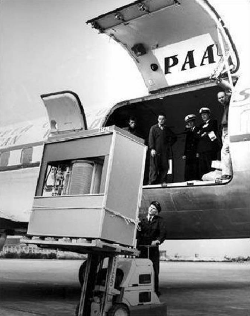
A friend sent me this 1956 photo with the heading "Guess What This Is?"  I recognized it immediately as some kind of data storage for an early computer.


It's the hard drive for IBM's model 305 RAMAC computer.  It weighed around 1 tonne and stored 5 megabytes of data (equivalent to one JPEG photo from a modern camera).

About 25 years after that photo was taken, I was writing software in an early attempt to automate the complex task of starting up a paper machine. The chosen computer had a 24-bit processor and held 48 megabytes of data on huge interchangeable disk packs. The computer room looked like a kitchen: the computer was the size of a refrigerator, the disk drive the size of a dishwasher, and each disk pack resembled a very large cake cover. The price of the whole system would have bought two 3-bedroom townhouses.

The computer had only one programming language, a crippled version of FORTRAN that limited each  compiled program to 1500 bytes and did not allow subroutines. We got around that by using hundreds of programs that called each other as they terminated.

The budget was limited, so we had to perform tests to determine process conditions for which no sensor had been purchased. The tests took a long time, so in the end our automated approach was no faster that an experienced operator. Still, we managed to publish a paper about our experiences!


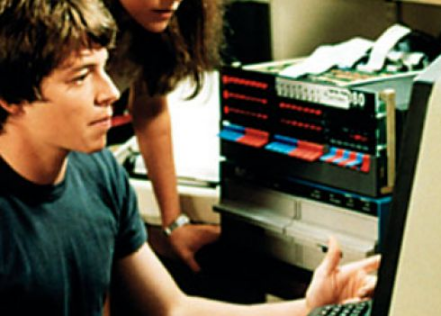
Around that time the movie "War Games" was released, about a teenager who accidentally comes close to starting World War III while hacking into what he thinks is a new computer game, but is actually NORAD's war strategy simulator. I show this exciting movie to my students to demonstrate the progress we've made in the past 30 years. 

The War Games sets are packed with early 1980s computer systems.  In one scene, the actors walk through NORAD's computer centre, a cavernous room filled with huge tape drives and computers.  I make my students count the items and estimate their approximate volume.  Then I have them apply Moore's Law to answer the multiple-choice question: "Today, all that computing capability would fit inside a...".  Six years ago, the correct choice of answer was "backpack."  Last year it was "smart phone"  By next year it will be "wristwatch."

Postscript, 2015-01-26: We recently found the "backup logbook" we kept for our home computer, starting in early 1994. We paid $342 for a tape drive and $102 for three tapes, and made backups faithfully once a week. After several years we switched to CD-RWs. Today we back up over our home network to a mirrored server. I'd like to think that our future systems won't have any moving parts, but we've seen a couple of solid-state drives fail badly, so we'll always need backups!


Thursday, May 06, 2010

The Aeroplane (1962)

For all those who think engineers can't write poetry!

- - - - - - - - - - - - - - - - - - - -

The Aeroplane
(c) 1962 Alan T. Chattaway

O Aeroplane!  Thou gleaming silver bird,
Shimmering in thy glory, hear my word,
For I too long have tarried in this land,
And now my eye grows feeble, and my hand
Trembles to write these words, my weary plea:
O Aeroplane!  Please take me to the sea!

When I first brought my soul to Rhodes' fair land
My fate lay in the noble pilot's hand.
Through sky and cloud he safely brought me in
While I, through youth's sweet nature, trusted him.
He set me down, and I stepped out anew
Into the land where all my dreams came true.

Thus seemed it to me then - but now, alack!
The burden of my years lies on my back.
I long to visit lands beyond my own,
Forget my labours - leave my cares at home,
And, thus released from worry, to ensure
I once again will hear the ocean's roar.

My wish it is, therefore, that I should fly
Down to the place where earth and sea meet sky.
The Aeroplane - that silver eagle there -
Must list to me, must hear my weary prayer,
My longing cry, the lonely person's plea:
O Aeroplane!  Please take me to the sea!


- - - - - - - - - - - - - - - - - - - -


Background

In 1962, halfway through my first year as a boarder at Gilbert Rennie School* in Lusaka, Northern Rhodesia, I entered a writing contest open to all high school seniors in the Federation**.  The topic was "Why I would like to go on a Central African Airways all-inclusive holiday to the sea," and if you won, you would get that trip.

The contest was open to both prose and poetry, so I decided to write a poem as a bit of a lark - though I can see that I gave it my best shot, and harboured deeper feelings than some might expect of a 16-year-old.

A couple of months later I received good news and bad news.  The good news was that I had won!  The bad news was that the judges were unable to choose between my poem and a prose entry by a girl, so they had split the first prize between us.  Rather than one of us receiving the promised trip to the sea, each of us could fly anywhere within our own landlocked Federation (a judgment worthy of Solomon!).

I used the opportunity to visit my friend Jeremy Thorne at his home in Malawi.  Since I had to change planes in Salisbury***, and because I planned to study engineering, CAA took me on a personal tour of their maintenance department in Salisbury between my flights.


Verse 2 recalls my arrival in Northern Rhodesia at age 6.  I came from England, where luxuries like candy were still rationed 7 years after World War II.  When I arrived at Ndola airport, I saw some candies in the tearoom and asked my dad "are they on coupons?" (knowing full well that they were not - children manipulate their parents!).  My dad bought me the entire jar! 

[Update 2010-08-07: I left Africa in 1968 without a written copy of this poem, and re-wrote it from memory a few years later. Today I found the original [with typos] in our 1962 school magazine, posted by Chris Waller at http://homepage.mac.com/wallerc/.Public/GRS1962mag.pdf. My memorized version was accurate except for two words, which I have now corrected above, and I have also corrected these notes.]

     * now Kabulonga School for Boys
   ** The Federation consisted of Northern Rhodesia, Southern Rhodesia and Nyasaland.  In 1964 the Federation was dissolved and the countries were renamed Zambia, Rhodesia and Malawi.  Rhodesia was later renamed Zimbabwe.
 *** now Harare, Zimbabwe

Friday, March 12, 2010

What's a PDA?

Each month after reading the latest issue of Consumer Reports, I shelve it and discard the oldest copy on the shelf. Today, before recycling the June 2002 issue I glanced at its review of PDAs.

PDAs? Does anyone still remember that acronym?

A Personal Digital Assistant is like a smartphone, without the phone. I still use the Palm IIIxe I bought in 2000 as my calendar, diary, notepad, e-book reader, etc. It even has a copy of the entire Bible, and plenty of room for other data in its 8MB memory.  What shocks me today is that my Palm cost as much then as a good netbook costs now.

Palm introduced the first successful PDA in 1996. Apple had failed in 1993 with a PDA called the Newton; its inability to reliably recognize handwriting was the butt of many late-night TV jokes. (I've also read that the Newton doesn't recognize dates past 2009; what were they thinking?)

By 2002 there were dozens of PDAs. Palm was dominant, but Microsoft was trying to take over with "Windows Mobile." (8 years later, they're still trying with "Windows Phone 7".)

The biggest surprise is the high prices we were willing to pay in 2002:
  • Cheapest PDA $150
  • Average non-Windows PDA $320
  • Average Windows Pocket PC $560
  • The one smartphone in the group cost an extra $230
The falling cost of electronics is part of what economists call the "Wal-Mart effect" that has kept overall inflation low for a decade, while the price of essentials like homes, food, and energy rises faster than the inflation rate. Great for the wealthy, but tough on people who are just getting by.

And where are PDAs today? They morphed into smartphones, and are now handed out free with 3-year phone contracts!

Sunday, February 28, 2010

Keep TV stations' hands out of our pockets

The Canadian Broadcasting Corporation is campaigning to force Canadian cable TV companies to pay TV stations for the privilege of carrying their signals. This seems entirely backward to me!

Cable TV started around 1950 and was then called Community Antenna TV (CATV). At that time all TV reception was through antennas. People who lived far from the transmitter needed a big antenna to get an acceptable picture. Because these antennas were very expensive, whole neighbourhoods agreed to share the cost and the signal, and CATV was born.

So cable TV subscribers pay the full cost of bringing TV signals into their home. Without cable TV, the TV stations would have a much smaller audience; in fact, it would make more sense for the TV stations to pay the cable companies for this service, then hit up their advertisers for more money for "delivering more eyeballs" (as they say in the trade).

All communications in Canada are regulated by the Canadian Radio and Telecommunications Commission (CRTC). Under CRTC rules, Canadian cable companies must carry local stations, and all cable customers must pay about $200 per year for those stations (this is called "basic cable"). Only then can customers add "specialty" channels like movies, sports, ethnic etc.

So customers are already forced to pay to receive stations they
can get for free by sticking a bent coathanger into their TV's antenna socket. Now, in addition, the cable companies will be forced to pay a new tax to subsidize local TV stations. The cable companies, quite understandably, intend to pass this tax on to their customers - and the CBC is even campaigning against that.

International comparisons show that Canadians pay more, for worse service, in all the fields the CRTC regulates - home phones, cell phones, cable and satellite TV, and Internet service.
We would be better off if the CRTC was scrapped and replaced by a body that put customer needs first, permitted more competition, and allowed unpopular services to go out of business.

The CBC website wants me to urge my government to both support this new tax AND prevent cable companies from passing it on to their customers. Instead, I urged my government to end the free ride for local TV stations by allowing cable subscribers to opt out of "basic cable". If half of us did that, together we would save almost a billion dollars per year.

Monday, February 01, 2010

Carbon tax weeds out everyone who isn't rich

From the National Post, February 01, 2010 (summarized)
(http://network.nationalpost.com/np/blogs/fullcomment/archive/2010/02/01/adrian-macnair-vancouver-can-t-afford-to-live-there-can-t-afford-to-commute.aspx)

The Pembina Institute, a left-wing think tank, says the current 3.33¢ per litre carbon tax in British Columbia needs to increase to 50¢ per litre - and that's in addition to federal and provincial sales taxes, plus other taxes that subsidize public transit.

British Columbia already has the highest gasoline prices in Canada because of these taxes, and raising them will make commuting even more expensive. But Vancouver also has the most expensive housing in Canada, so people are forced to commute to work from cities 30 km to 60 km away. Since the high speed public transit system doesn't reach the places where most commuters live, commuters have no choice but to pay the high gas prices.

Carbon taxes, in effect, are a way of rooting out middle and lower income workers who can't afford to live in Vancouver, and soon won't be able to afford to commute to Vancouver either.

My comment:

For those who do have access to transit, the fares are so high that two people travelling together spend almost as much commuting by transit as they would commuting by car - and even more if they have to drive to the transit station and pay to park there (especially with our new 21% tax on parking fees, plus federal and provincial taxes on top of that).

I've always thought that increased taxation is the worst way to try to fix environmental and other problems. Higher taxes hit the poor hardest. Taxes that hit working families hurt children twice: they have less money today, and their parents are forced to forgo saving for their retirement, so their children will have to care for them then and won't see much of an inheritance.

My parents lived through World War II and the postwar era when goods of all kinds were scarce. The government issued ration coupons to make sure everyone, rich or poor, got their fair share. There is no reason why environmental resources, such as the right to emit a certain amount of carbon, can't be shared equitably through rationing.

A common objection to rationing is that it creates a "black market" in the scarce goods. But there is really no moral objection to people trading their share for something they need more. And if the rationing is done through a secure network like the ones that support credit and debit cards, not only can the scarce goods be traded freely, but these transactions can even be taxed!

A rationing system would be better for the environment because it would directly limit the consumption of the scarce goods, instead of trying to influence consumption by overpricing them. And a free market in "ration rights" would produce a fairer distribution of consumption at a lower overall cost to consumers.

So why don't we do it that way? Two reasons: it's hard for any politician to admit that the real goal of punitive taxation is to create a de facto rationing system. And it's also hard for any government to resist an opportunity to collect taxes. When our governments are willing to level with us about the former and forgo the latter, we will start making progress on this issue.

Thursday, October 15, 2009

Design vs Engineering

A lot of products these days seem to be impractical and have features designed strictly for "showroom appeal". A case in point is the high trunk decks, low roof lines and thick rear pillars on many current cars. These combine to hamper visibility to the rear, contributing to many road and parking accidents. Ironically, many of these vehicles now offer optional "rear visibility packages" consisting of a rear camera and a front video screen. An engineer would simply have put in bigger windows with thinner pillars. [Update 2012-10-31: A bill making its way through the US government would make such cameras mandatory on all future vehicles.]

The entire Apple product line is full of such design features, and since Apple's products are so fashionable, these ideas are now being copied by their competitors. To list just a few of the undesirable features of the Mac laptops I have worked with:

  • white case shows every speck of dirt
  • lid hinge design limits range of screen viewing angles
  • slot-loading DVD drive won't accept camcorder DVDs
  • flat-topped keys give no tactile feedback for centering fingers
[Update 2010-07-02: According to Computerworld, Apple's new iPhone 4 "represents, above all, the new power of designers over engineers and usability specialists...in three design areas [shape, antenna, case] Apple had a clear choice between elegance and usability, and chose elegance every time" The writer says the iPhone 4 is heavy, fragile, and drops calls unless it's held in a special way. See http://www.computerworld.com/s/article/9178536/iPhone_4_Triumph_of_the_design_nerds.]
[Update 2012-10-31: Apple's iPhone 5 has got rid of the non-functional glass back of the iPhone 4, and now brags about how much thinner it is!]

Wednesday, March 11, 2009

You shall not commit adultery

We usually associate the commandment "you shall not commit adultery" with unfaithfulness to one's marriage partner. However, the word "adulterate" has a much broader meaning: "To make impure by adding improper or inferior ingredients."

In recent years no country has been more in the news for adulterating its products than China. Here are some instances that I remember:
  • Pet food made from Chinese gluten (wheat protein) killed pets in Canada and the US. Food companies test the gluten they buy by measuring its nitrogen content, since protein contains nitrogen. The Chinese supplier sold them low-quality gluten adulterated with melamine, an inexpensive chemical high in nitrogen. The gluten passed the tests, but killed the pets. (Wikipedia article)
  • Metal figurines from China worn on children's charm bracelets are frequently recalled because they often contain a high percentage of toxic lead. (A typical recall) [Update, January 2010: "...some Chinese manufacturers [now] use cadmium, a carcinogenic heavy metal, to make charm bracelets and shiny pendants sold in the U.S. because they are banned from using lead..." - Business Week quoting Associated Press: ]
  • Painted toys made in China for major US companies had to be recalled when they were found to have lead-based pigments in the paint. One Chinese factory owner, distraught that a lifelong friend had sold him the paint with an assurance that it was lead-free, committed suicide. (Guardian.uk story)
  • Drug companies had to recall heparin products in the US and Europe because the Chinese source of the raw material (unrefined heparin) had deliberately adulterated it with a similar molecule that appeared to be heparin on standard tests, but killed patients. (New York Times story)
  • A major milk company in China discovered that the milk it was buying had been watered down and then adulterated with melamine to make it pass tests of protein content. The company concealed this problem for several months, perhaps to avoid a scandal during during the Beijing Olympics; during this delay they sold baby formula made from the contaminated milk, permanently harming thousands of babies. The problem was only revealed when the company told its major shareholder in New Zealand. Products containing Chinese milk were recalled all over Asia, and as far away as Canada and the US. (Times (UK) story)
  • An Australian company sold a children's craft kit containing beads that stuck together when sprayed with water. It had to recall all the kits when children began going into seizures and comas after swallowing the beads. It was discovered that the Chinese factory making the kits had replaced the safe but expensive glue with a cheaper chemical that turned into the drug GHB when swallowed. (New York Times article)
And those are just a few cases that I remember. After all that, my imagination had run out of new ways for Chinese manufacturers to poison their customers, but apparently theirs had not. Here are two news stories in today's Vancouver Province newspaper:

(Toxic Wallboard Story) (Are you affected?)

According to these news stories, since 2001 Canada has imported nearly 1,000,000 square metres of Chinese wallboard (North Americans call it Gyproc or Drywall). That's enough for 600 complete houses or 2000 apartments. Now some experts are saying that if your home has as few as three panels of that wallboard (one short wall!) your home may be unfit to live in and should be bulldozed. So this problem could affect tens of thousands of homes in Canada.

Wallboard is supposed to be gypsum (calcium sulphate). In Canada and the US the gypsum is usually from a mine or recycled from old or scrap wallboard. But the Chinese wallboard was made from calcium hydroxide that had already been used to "scrub" the smoke from power stations. Toxic substances removed from the smoke were absorbed by the calcium hydroxide, and are now being released from the wallboard into Canadian homes.

The main toxin is
hydrogen sulphide which causes (here I quote the newspaper) "serious health conditions and illnesses, such as shortness of breath, dizziness, headaches, fatigue, insomnia, eye irritations and respiratory difficulties". Nosebleeds are mentioned elsewhere in the story.

Hydrogen sulphide smells like rotten eggs, but our noses quickly get desensitized to it, so you won't smell it most of the time. But if you smell rotten eggs right after entering a closed building from the fresh air, it's probably there all the time. If you have any of the symptoms above, and they clear up when you go away for a few weeks, that's also a clue. Since hydrogen sulphide corrodes metals, two other good clues are that your silverware tarnishes quickly, and when an electrician checks the wiring behind your switches and outlets it looks blackened and scorched. The news stories recommend that if you suspect this problem is affecting your home, you should call researchers at America Watchdog's Chinese Drywall Complaint Center, 1-866-714-6466 or visit http://homeownersconsumercenter.com/.

This case, and all the cases I listed at the start, involved someone cutting costs by replacing a safe but expensive substance with something cheaper that is harmful to our health. These adulterated products are destroying China's reputation, which is unfortunate because the world needs China to succeed. The present political reality there, though not ideal, is better for the average Chinese citizen than any other regime that has prevailed in China during my lifetime; remember the Great Leap Forward (1958-60), the Cultural Revolution (1966-1976), and Tiananmen Square (1989)?

Europe and America also had their era of unregulated trade in dangerously adulterated products, an era that ended only a century ago; let's hope that China catches up fast in this area, for everyone's sake.

Friday, August 22, 2008

RIP Plymouth Acclaim

Yesterday I drove my 1993 Plymouth Acclaim (odometer reading 392,540 km, equal to 244,000 miles) to the scrapyard, which gave me a certificate entitling me to a reward from our provincial government's Scrap-It program. The reward is worth more than the car, so I'm ahead. (If you live in British Columbia and are interested in this program, see http://www.scrapit.ca/. Your car or light truck must be 1995 or older, licensed in this province for the past year, and still drivable. Rewards range from $1200 to $2250, depending on what you replace your scrapped vehicle with.)

During my Plymouth's lifetime I recorded every expense along with the date and odometer reading (kilometres), and now that the books are closed I've done some analysis. You may be surprised to learn the true cost of operating a vehicle. It's more than fuel; it includes scheduled maintenance, repairs, insurance, and depreciation.

Back in 1994 when the car was new, fuel was cheap (40 cents per litre) and no repairs were needed, but depreciation was high. As the car aged, depreciation decreased but repairs increased, and fuel has risen steadily and is now $1.45 per litre. The net result is that the operating cost began at 10 cents/km and rose 10% every year, reaching 37 cents/km this year - about the same operating cost as a new vehicle. The 15-year average was 18 cents/km.

The annual cost to drive 16,000 km/year averaged $3,600 per year, or $10 per day. Remember, that's a 15-year average; currently (2008) it's $4,800 per year, or $13/day.

Consumer Reports has two pithy sayings about when to replace your car: (1) "The cheapest car you will ever own is the one you own now." (2) "Don't replace your car unless (a) it can't be made safe, or (b) the repairs will cost more than the car is worth." Over the past year, in anticipation of the end, I deferred several repairs that together were worth more than the car itself. With its clunking suspension, clicking CV joints and (recently) its tendency to run hot, I was not sure it would still be "drivable" so I could claim the reward. But it made it.

My replacement car is a 2005 Toyota Echo, the least expensive vehicle on Consumer Reports' list of "reliable cars with good fuel economy". I chose the four-door automatic model, not the even more economical stick-shift hatchback. So far, in mostly city driving it has averaged 8.3 litres per 100 km, which beats my old Plymouth Acclaim by more than 25%. For my readers who use gallons, that's 29 miles per US gallon or 34 miles per Imperial gallon.

[Update, August 2009: I've now had the Echo for a year, including a fierce winter, a hot summer with the air conditioner running constantly, and a 3,000 km trip this month to Edmonton and back on winding mountain roads. Prior to the Edmonton trip,
overall fuel economy for the year was 8.6 L/100km (28 miles per US gallon, 33 miles per Imperial gallon). But the real surprise was the Edmonton trip, which averaged 6.2 L/100km (39 miles per US gallon, 46 miles per Imperial gallon).


[Update, August 2012: The Echo now has almost 100,000 km, and seems just as good as when I bought it. Maintenance has been inexpensive, except that the air conditioner needed a new condenser.

Meanwhile, my wife's 1993 Plymouth Voyager minivan reached 450,000 km and needed repairs worth more than the vehicle, so we replaced it. She still needed a flat loading space with sliding doors to load musical equipment for her concerts, but with our nest almost empty a minivan was too big. She loves her 2010 Mazda5, purchased through Robert Montgomery of Quinella Auto Brokers. I know he found us a great deal, because I've seen the dealer's net cost - it's available through Consumer Reports.]

Tuesday, April 22, 2008

Idioms and metaphors

The first rule for communicating in English with someone whose native language is not English is: avoid idioms. Idioms are those sayings that mean something different from the plain meaning of their words. They are closely related to metaphors, which are similar but shorter - I see metaphors as idioms that have been whittled down through long usage to just one or two words. ("Whittled down" is a metaphor.)

The idiom most often cited by English teachers is "raining cats and dogs," which means "raining heavily". In this context, "heavily" probably started out as a metaphor for "a lot", but now has come to actually mean that.

Sometimes we forget that our expressions actually are idioms (or metaphors). We often read in the newspapers that a building was "gutted by fire"; this ought to feel like a strange mixture of concepts, because the expression "gutted" is derived from the practice of cutting open an animal one is going to eat, and pulling out its guts because we prefer not to eat those parts. So the term "gutted by fire" originally meant that the exterior of the building remained standing but its interior had been destroyed. Today, "gutted by fire" may simply mean "destroyed by fire", and no longer retains any mental connection with the butchering of food animals.

If you are a native speaker of English, idioms can sneak up on you and be out of your mouth before you realize it. After you have used an idiom and realized that it has confused your listener, you may even catch yourself using another idiom to try to explain the first one. For example, if you say "I can pull this off" and see only a blank expression, you might explain that "pull this off" means "get away with this". You have simply swapped one idiom for another, and you are no closer to explaining the plain meaning, which is "I can do this without experiencing negative consequences, such as being arrested."

And then there are the cases where an idiom becomes confusing because the plain meaning of the words intrudes into the meaning of the sentence. It is one thing to say "she broke off her engagement to the sailor"; quite another to say "she didn't like the tattoo on his arm, so she broke it off".

News articles and headlines often contain idioms or metaphors for which the plain meaning is related to the topic. An article about birth control may use words like "conceptually", while one about guns may use words like "triggered". Psychologists say that writers do this unconsciously, which is more than we can say for the headline writers who give us such gems as
"Auto workers drive hard bargain," or "Fire chief marries old flame."

Sometimes the mental image caused by an inappropriate idiom or metaphor is very funny. I once read a technical book about the process of making pulp and paper. One of the first steps when a log arrives at the factory is to remove its bark. The book said this was usually done by hydraulic jets, but "in some older mills, barking is done by dogs on chains." I pictured rows of restrained rottweilers making a fierce din. What the author was really talking about was sharp metal objects, metaphorically called "dogs", attached to a bicycle-type chain that scrapes the outside of the log.

And yesterday, CBC Radio 1 interviewed a fashion designer who promoted one of her creations : "It looks like a sack on the rack, but it looks good on any body. Anyone can pull off this dress." You can imagine the mental images that brought to mind!

So if your goal is to be understood, speak plainly whenever you get on your soapbox. (Oops, see how easily they sneak in...)

Sunday, March 11, 2007

The origin of the Unity Candle ceremony?

When Kathy and I were married in May 1969, the minister who performed our ceremony challenged us to re-think the function of the various traditions about weddings and if necessary, create our own.

We wrote our own vows (now commonplace), and instead of a traditional wedding cake we distributed scripture portions we had signed and dated as souvenirs of our wedding. But the innovation that seems to have been completely original and had the most lasting effect on others was our decision to improvise a ceremony involving two candles.

Early in the ceremony, we had our candle-lighter light a pair of tall candles standing in separate bases side-by-side on a table near where we were going to stand during the ceremony. These two candles symbolized us, the bride and groom. When the minister pronounced us "husband and wife", we rotated the candle bases. We had deliberately inserted the candles into the bases not quite vertically, but at a slight tilt. The tilt was originally leaning away from the congregation, to make it almost unnoticeable. When we rotated the bases, the two candles now tilted toward each other and touched at the top, burning with a single flame and becoming welded together by the wax running down and filling the gap between them. We kept these merged candles on our bedroom dresser for many years after the ceremony.

Neither of us can recall ever seeing or hearing of such a ceremony before our own wedding. We believe it was an original idea that came to us as we planned our ceremony. A year or two later, we attended the wedding of a friend (who had attended our wedding) and saw a similar ceremony, except that this time the original two candles were used to light a third, central candle and were then extinguished, so that only the central candle remained alight.

After that, we began to see similar ceremonies at many of the weddings we were invited to. Today, the minister often announces "the lighting of the unity candle" as if this had always been an integral part of the wedding ceremony. Wedding planners have a checkbox for "Unity Candle ceremony" on their checklists. Catholic websites explain why this ceremony contradicts Catholic tradition concerning the use of candles. There are catalogs of expensive unity candles. There are websites that describe the correct etiquette for the ceremony, and give versions of the ceremony that involve the couple's parents and even their children from previous marriages.

Yet there are also websites that claim the tradition is only ten years old, and Wikipedia (http://en.wikipedia.org/w/index.php?title=Unity_candle) was able to trace this ceremony back only as far as 1976 in Illinois. The church we were married in (Mennonite) is a very close-knit community with many congregations in Illinois, so it's entirely possible that our ceremony had taken root there by 1976.

Given the above facts, we (Alan and Kathy) sincerely believe that we invented this modern ceremony. Of course we would be happy to relinquish this claim if anyone can provide evidence that it is even older than 1969. There are many instances on record of someone producing what they believed was an original work, only to learn that it was based on a forgotten memory. So if you can prove an earlier instance of this ceremony, let me know.

Update 2007-07-30: When I first wrote this in May 2007 I added a brief summary of it to the Wikipedia entry on "Unity Candle", with a link to our website for the full story. Amazingly, an anonymous user felt free to alter the details of our wedding, claiming that Kathy and I created this ceremony because "their mothers...insisted on a significant role in the ceremony." The truth is that on our wedding day, my mother had been dead for nearly three years, and Kathy's mother wasn't involved in our candle ceremony. Another user removed the link to our website and replaced it with a link to this blog entry, which has the exact same content. Wikipedia is a useful resource, but apparently it's also a playground for those with time on their hands and/or an axe to grind.

Sunday, November 26, 2006

A vote of no confidence

The 6 November 2006 issue of eWeek magazine has an article titled "A vote of no confidence" about the mess created by the rush to computerize voting systems in the US. One of the people they interviewed, Avi Rubin, a computer science professor at Johns Hopkins University, says "Election officials...didn't even consider huge issues such as the lack of audit capabilities [or] the security implications. The result was the adoption of a bunch of half-baked solutions that by no means can be considered a reasonable way to conduct trustworthy elections. If you were in charge of a private-sector project like this, you'd get fired - it's that simple."

But although the officials responsible for the e-voting snafu could not see the problems with the systems they purchased, there is no such excuse for the computer professionals who developed these flawed systems. The lack of any form of audit trail in these systems was an intentional design decision - but why? The most benign interpretation I can think of is that the designers don't want anyone to know when their systems malfunction. Obviously, much more sinister interpretations are possible. And that's before we consider the ease with which these systems can be compromised (hacked), and the apparent links between
one of the manufacturers and a foreign government critical of the US.

The question that puzzles me is why any kind of machine is needed to hold an election. Here in Canada I have worked as a poll official on federal and provincial elections. My poll clerk and I seal the empty ballot box at the start of the day, and never leave it unattended. Each ballot has a serial-numbered stub. In federal elections I sign the back of the unmarked ballot to prove its authenticity. The voter marks it with an X, folds it and brings it back to me. I detach and retain the stub, and the voter puts the ballot in the box. Due to our constant surveillance it's impossible to stuff the box, but even if that were to happen, it would be obvious since the number of ballots would exceed the number of stubs; and in a federal election the false ballots would lack my signature.

At the end of the day my poll clerk and I open the box and count the ballots, under the close scrutiny of the candidates' representatives. We immediately give the results in writing to the candidates' representatives and telephone them to the central reporting office for the district. Because the information is made public as soon as it's available, there's no point in tampering with the ballots after that time except perhaps in very close races that require a recount. To prevent that, we immediately seal the counted ballots and courier them to the central office, which locks them up in case a recount is ordered.

This system, using nothing more complex than a pencil, produces results quickly and transparently - everyone can see how it works, so they have confidence in it.

Getting voters registered also seems to be a big issue in the US, but not in Canada. The reason is that we register simply by putting a check mark on our income tax returns. And in Canada everyone submits an income tax return; even teenagers and those with no income submit a tax return, because that qualifies them for a quarterly payout that's advertised as a rebate of the federal sales tax, but is really a come-on to get people registered as voters and taxpayers. And for those who somehow contrive to miss getting on the voter's roll, we sign them up at the polling station and seal their vote until their eligibility is confirmed, at which time we add it to the pool of votes. Nobody gets turned away on election day!

Friday, October 27, 2006

Canada Post allows workers to discriminate

Yesterday, Canada Post gave its delivery workers in Vancouver permission to refuse to deliver a paid advertising flyer that some of them found offensive.

This is a dangerous precedent, and one that should be reversed immediately. As long as the material is legal, Post Office workers should have no right to refuse to deliver it.

If individual posties can decide which mail is fit to deliver, we could see, for example, Muslim posties refusing to deliver ads for winemaking shops, Jewish posties refusing to deliver ads for restaurants that serve shrimp and pork, posties who are members of the United Church refusing to deliver ads for bottled water*...where would it all end?

The Post Office has a legal monopoly on mail delivery, making it a public trust that must serve all Canadians who have information to convey. It cannot be in the business of censorship, or allow its workers to determine what mail is fit to be delivered.

A few years ago our courts decided that a private business person in Ontario, Scott Brockie, had no right to consult his own conscience in deciding which organizations his company would work for. The decision was firmly upheld on appeal, at considerable cost to Mr. Brockie**. If that is the law for a private business -- which had plenty of competition waiting to accept the work it refused -- then surely it must also be the law for a public monopoly like the Post Office.

If the printed material itself is legal, then the Post Office must deliver it. Postal employees who refuse must be disciplined or dismissed. Nothing else meets the test of fairness.

(* When I posted this, the United Church of Canada was campaigning to get people to stop buying bottled water and donate that money to third world water projects.)

(** There is a lot of information about the Scott Brockie case on the web. If you have time to read only one article, see http://www.lifesite.net/ldn/2004/apr/04041604.html)

Saturday, October 14, 2006

A conspiracy or just a bug?

My son showed me that if you save a text file containing the sentence "bush hid the facts" (typed exactly like that, without the quotes), and then open it in Windows Notepad, all you see is a row of 9 rectangles. At first glance this looks like an "Easter egg", a surprise planted by programmers, like the flight simulator game in Excel 97. But hiding Easter eggs in a Microsoft program will get you fired these days.

It turns out that the explanation is more mundane, and there are many sentences that will do this to Notepad. It's all explained (to programmers, anyway) at:

http://dhilung.blogspot.com/2006/08/technotepad-facts-behind-bush-hid.html

What's really happening here is that Notepad examines every text file it opens to see if it was written in Chinese (or some other non-Roman alphabet). But text files don't actually contain anything besides the text -- certainly nothing that could indicate the language or font used. So Notepad simply assumes that if the order of bits in the file matches a string of Chinese characters, then that's what it must be. And if Notepad isn't configured to display Chinese, it displays a rectangle instead of each Chinese character.

Besides "bush hid the facts", here are some other sentences that behave this way in Notepad.

"this app can break"
"What are you doing"
"Matrix can not lie"
"Osamabin laden leading all terrorist"

and my favourite,

"We can blast Microsoft for a new bug"

If you're observant, you'll notice that there are exactly half as many rectangles as the number of letters in the English message Notepad should be showing. You can even make up your own messages that break Notepad -- if you can understand the instructions at the blog post linked above.

Tuesday, January 24, 2006

End of the line for camera makers

http://www.guardian.co.uk/japan/story/0,,1690893,00.html

This is a real tear-jerker. I remember how in the 1950s, getting into serious photography was a "rite of passage". And while there were all sorts of cameras, those that used 35mm film were the clear choice of photo enthusiasts and professionals alike.

It really felt like 35mm photography would be here forever. Originally created to take advantage of the low cost of 35mm movie film, 35mm cameras survived the rise and fall of Polaroid's instant pictures, Kodak's Instamatic format (size 126) which (despite the name) did not create instant pictures but only simplified loading the film, Kodak's Pocket format (size 110), Kodak's Disc format, the Advanced Photographic System (APS), and many other formats and innovations. Most of these were not really needed, but were created because market research showed that people took the most pictures in the first two years after getting a new camera. In other words, new formats were invented to help sell film, paper and chemicals -- and, of course, cameras.

And through it all, the skills we learned in our high school days (in the 1950s) about exposure compensation and darkroom work (dodging and burning, solarization etc.) were still valid and valuable -- until now.

But in just a few years, digital photography has decimated sales of film and traditional film cameras, and now after sustaining huge losses Konica-Minolta (the two companies merged just 3 years ago) has announced it is getting out of the twin businesses of making cameras (of all types!) and film, to concentrate on making photocopiers and its other "imaging businesses" that are still profitable. To see Konica-Minolta reduced to taking this action is a blow close to home, because back in the 1970s when our children were small and we took a lot of pictures, many of them were taken with our Minolta Hi-Matic F and our Konica C-35, little gems of rangefinder cameras that did everything well. So this announcement is a bit like hearing about the death of an auntie you were once close to, who spent her later years in "reduced circumstances" as the British say.

Oh, and I hear Nikon is also dropping almost all of its film cameras. Who's next? To borrow Alvin Toffler's phrase from Future Shock, the future has arrived awfully fast for some of these companies.

On the digital front at home, we recently got our second digital camera (a Canon 620) after our Fujifilm 2600Z (about 3 years old) suddenly lost its ability to focus. By today's standards the Fuji is obsolete, so it's not worth repairing. The Canon is vastly superior to the old Fuji -- some review sites call it simply one of the best digital cameras available -- yet it cost about the same as the Fuji did 3 years ago. I'm impressed by the Canon's solid feel, its even illumination on flash shots, its intelligent autofocus system that seeks out -- and marks on the screen -- the key objects it has decided to focus on, and the way it applies just enough processing to each picture that you could use it without retouching, but still have room to enhance it to your own taste. Oh, and the quality of the lens.

Still, in a sign of the times, although I got the Canon 620 at a rock-bottom price at a Boxing Day (December 26) Sale, I recently saw it advertised for $20 less than I paid for it just three weeks ago. I suppose in another three years it will be obsolete again. So although today's cameras are great bargains compared to camera prices in the 1960s and 1970s, over time today's cameras may cost us more than our 35mm cameras ever did.

Sunday, January 15, 2006

Vegemite not emigrating

From Agence France-Presse
Saturday, January 14, 2006

Kraft assures Australians that Vegemite is staying put

Global food giant Kraft moved to assure Australians yesterday that production of the famous Vegemite savoury spread would not be shifted overseas...

Kraft this week announced it would move its biscuit manufacturing business from Melbourne to China...The announcement had sparked fears that Kraft's Vegemite would meet a similar fate.

First produced in 1922, the thick brown paste with a strong, salty flavour is regarded as an acquired taste and is accorded the same status in the Australian national psyche as peanut butter and jelly sandwiches in the United States.

- - - - - - - -

The Observer says:

Vegemite is a yeast extract, rich in natural glutamates that stimulate the "umami" or savory taste receptors on the tongue. Since it isn't synthetic like MSG, it doesn't contain the indigestible left-handed isomer that is thought to cause "Chinese restaurant syndrome" and may contribute to glaucoma in people who regularly eat foods containing MSG.

Personally, I find Vegemite to be too bland and prefer the original British product, Marmite, which is over 100 years old. They are both yeast extracts, but Vegemite is flavoured with malt, whereas Marmite is flavoured with carrots and onions. A little goes a long way: a teaspoon is enough to impart a rich, meaty flavour to a pot of homemade soup.

Marmite is made all around the world. Most Marmite sold in North America comes from the UK through the "official" wholesaler. But some Chinese groceries import Marmite from Hong Kong, and I get mine from the South African Sausage Company which imports it from Durban.

Although most Americans and many Canadians claim to dislike Marmite, they buy lots of ready-made snacks, soups, and meat products in which "yeast extract" is a prominent ingredient. Ironically, some of our popular brands of sliced roast beef are flavoured with "yeast extract" to make them taste meaty!

Sunday, September 18, 2005

Dumbing down the English language

It was C.S. Lewis who commented that the fashion, popular in his day, that writing should be "functional" had robbed writing of half its functions. I wonder what he'd make of the state of English in our day. One has only to read ten pages of Lewis' The Voyage Of The Dawn Treader and then ten pages of Harry Potter and the Goblet of Fire to realize that the English language has undergone a significant decline in the 50 or so years between the publication of these two children's stories.

And J.K. Rowling is not the worst offender. My candidate for the worst influence on the learning of English is: school textbooks. This is fresh in my mind, as I recently took a position as a high school teacher and am trying to come to terms with the new generation of textbooks. Those I learned from in Central Africa in the 1950s and 1960s looked a lot like The Times - simple text laid out in sequential paragraphs, with an occasional headline or line drawing. By contrast, today's textbooks look more like People or USA Today - full of colour, profusely illustrated, and with fact boxes cluttering every page. I wonder how any student ever follows the topic, there are so many interruptions placed in his or her way.

And the English! I find that since I learned mathematics in the 1960s the word "percentage" has become extinct. "Express 3/4 as a percent" says the Grade 8 textbook, a grammatical blunder which would have brought a sharp rebuke from my math teacher had I made it in class. Likewise the word "subtract" has been lost in the mists of time, so that even Grade 12 students are likely to say "You have to minus the constant".

And it isn't just in the sciences that we face this crisis - for that's what it is - of the erosion of our language, which is our only means of expressing ideas to one another. Social studies textbooks talk about dictators being "driven by hate", oblivious to the fact that "hate" is a verb (I hate, you hate, he hates...) and that the noun required here is "hatred". If you use that word in a conversation today, there's a chance that you may be viewed in the same way as those old folks who still talk about a musical "record" instead of a "CD". Or, worse, you may get curious stares from people who think your grasp of English is so poor that you have begun making up your own words.

I think I'll go back and re-read my copy of "Eats, Shoots and Leaves" to reaffirm my own sanity!

Thursday, August 11, 2005

It‘s appearance beautify

I've always been a fan of what used to be called "Janglish" - the type of English found in the instruction books of Oriental products. (Nowadays it's more often called "Chinglish", which probably reflects an improvement in English language instruction in Japan.)
One of my favourite examples came from a Panasonic portable radio sold in the 1960s. Clearly, the translator had studied Shakespeare. In describing the transparent plastic case, he or she wrote:
"The cabinet is painted on the within, to shine beauteously on the without."
What a difference 40 years makes! Yesterday I saw a little round pocket-size USB plug converter in a local computer parts store. No Shakespeare here - this translator must have used a service like AltaVista's Babelfish or FreeTranslation.com to get a result like this:
"When you are traveling. Do you bring the very more USB cable? Is it very trable? Now, you have the flying savcer[sic] No 1, the door is throw wide open to your.”
Update 2010-02-11: We just bought some mandarin oranges individually wrapped in clear plastic pockets, each printed with the message below, spelled, punctuated and formatted exactly as shown:
MingHua mandarin is Orange,contain
of protein,sugar,vitamin and inorganic
salts etc,sorts of composition,especia
lly contains rich maize element, Vc,Vp,
and carotene,Resistant to cancet,he-
alth spleen,moisten lung,relieve a co-
ugh,it‘s appearance beautify,juice sa-
vory,flesh delicious,Not only is nouri-
shing product,but also is preserve yo-
ur health.It is good foodsfor health.
They are delicious!